Concept
For decades, industrial robots have been built under the same widespread approach by which the robot body contains only mechanics, motors, and sensors, while the control electronics, including the servo drives, are located inside a separate cabinet. This strategy is quite convenient to remove a traditionally bulky component, the drive containing the power electronics, from the space-constrained robot body, allowing it to be slimmer and lighter.
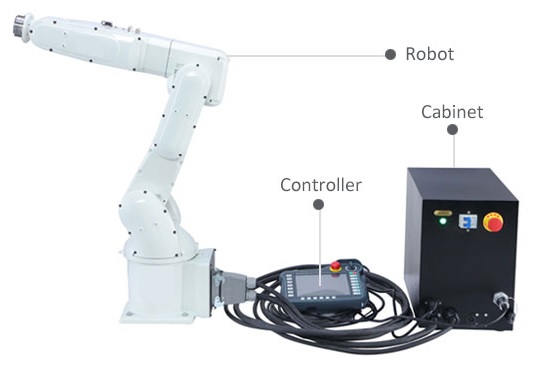
However, this approach has become outdated and is now the source of numerous wiring, EMC, and scalability challenges. These limitations have hindered the evolution of robotic systems, restricting the integration of higher power-density components, the adoption of more efficient power converters, and the transition toward modular architectures.
Collaborative robots, by contrast, were already born with those goals in mind. But to get modular, more flexible, slimmer, and safer bodies, the drives must be attached to the robot joints, as close as possible to the motors and sensors. Also, the established use of electronically-commutated PMSMs instead of power steppers or AC motors made modern miniature servo drives highly convenient.
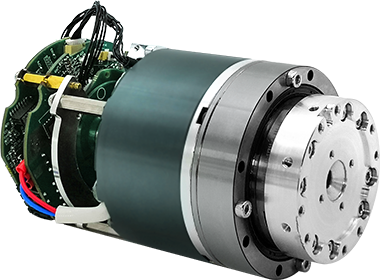
The term “miniature” servo drive is appropriate in this context, given that these robot joints require an entirely new level of integration. The component density is so high that, in many collaborative robots, routing pneumatic lines or end-effector-specific wiring through the interior of the joints is not feasible. As a result, these connections must be intricately routed around the robot structure. Furthermore, a compact joint form factor, whether flat or short, improves the overall mobility of the cobot. However, the electronics often occupy 30% or more of the total joint volume, resulting in joints that are larger than desired.
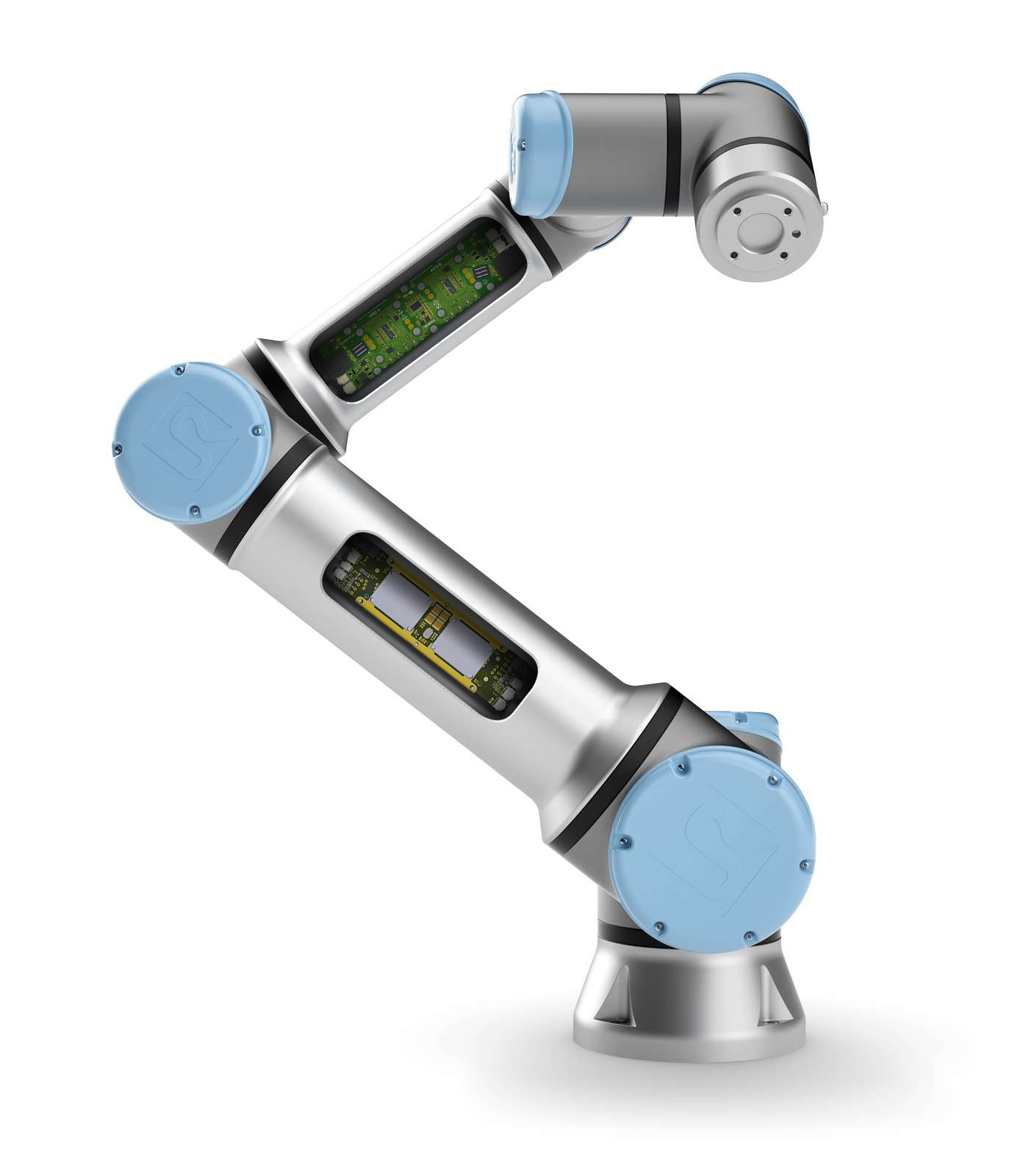
Even so, the metal parts connecting each joint to the next one, also known as mechanical links, are basically underutilized empty tubes in the majority of collaborative robots in the market. These mechanical links are often used only to pass wires through, while all the complexity of integration is allocated in the robot joints.
The proposed design here is intended to give an alternative to this common approach by using mechanical links to hold the power electronics. The strategy is not new, though, as it is widely used among surgical robots, which nowadays are at the forefront of robotic arm technology.
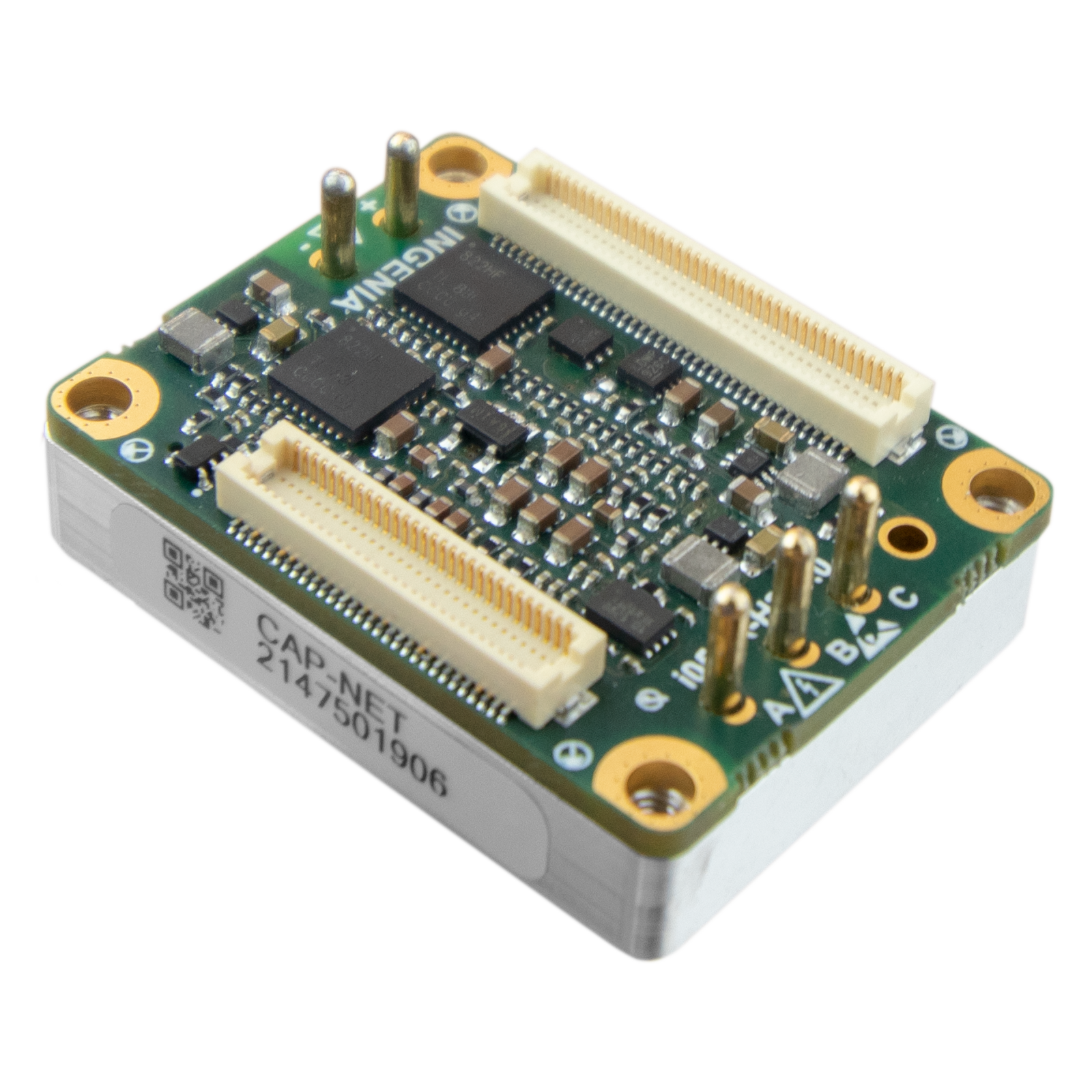
But unlike surgical robots, where each part is highly specialized and uniquely tailored to a particular robot, cobot manufacturers seek modularity, using a common range of joints and links to build larger and smaller robots. Where this modularity would typically entail the size of the servo drives to be adapted to the size of the joint for optimization, hence having to dedicate drives of different sizes and power ratings, this is not the case with the proposed design thanks to its main component, the Capitan NET miniature servo drive. With a power rating of 500 W in a footprint of only 34.5 mm x 26 mm, it can drive the bigger joints and still satisfy the space constraints of the smaller ones, enabling the same electronically-loaded mechanical link to be used in stronger and lighter robots.
Finally, although designed with collaborative robot arms in mind, this design example presents a powerful and versatile dual-axis servo drive that could be perfectly suited for many other applications.
Main advantages
-
Frees up space from the robot joints, typically the most space-constrained location in a cobot, yet is close enough to the motors and sensors to prevent eventual EMI issues.
-
Two 500 W advanced servo drives in a 140 mm x 38 mm footprint (excluding matings), can be embedded even a tube as narrow as Ø40 mm.
-
Power supply, STO, and EtherCAT daisy-chain connections embedded on-board: there is no need for aerial T-connections. Still, when embedded in a cylinder, leaves plenty of space to pass wires through the mechanical link.
-
Heat dissipation towards the largest and coldest metal parts of the robot.
-
The design can also be used in any other context requiring a dual-axis
Key features
-
EtherCAT ready
-
Up to 60 VDC, (logic supply DC/DC included), 10 A continuous (motor phase filters included)
-
Dedicated electromechanical brake output, motor temperature sensor input, and redundant Safe Torque Off inputs (STO)
-
Supports 2 simultaneous absolute encoders (SSI or BiSS-C)
-
Full voltage, current, and temperature protections
Typical applications
-
Collaborative robots
-
Robotic exoskeletons & wearable robots
-
Cartesian robots or CNC machines
-
Small AGVs or AMRs
-
Heavy gimbals or stabilizers
Specifications
See the Mechanical Specifications section of this guide for further details on the physical characteristics of the design.
This design example requires 2x CAP-NET-E servo drives. Check the full set of specifications in the Capitan NET Product Manual.